
Oral Biofilms
Study oral biofilms in biological conditions
The bacteria that make up the flora of the oral cavity have complex relationships within biofilms that contribute to dental caries and disease pathogenesis in the oral cavity and throughout the body. To study such relationships among bacteria, it is necessary to inoculate and culture the cells under shear flowFluid movement that applies force to cells and biofilms; used to mimic physiological/pathological conditions..
The BioFlux shear flow system enables high-throughput investigation of oral biofilms and antibiofilm treatments under biological conditions.
BioFlux oral biofilm general workflow
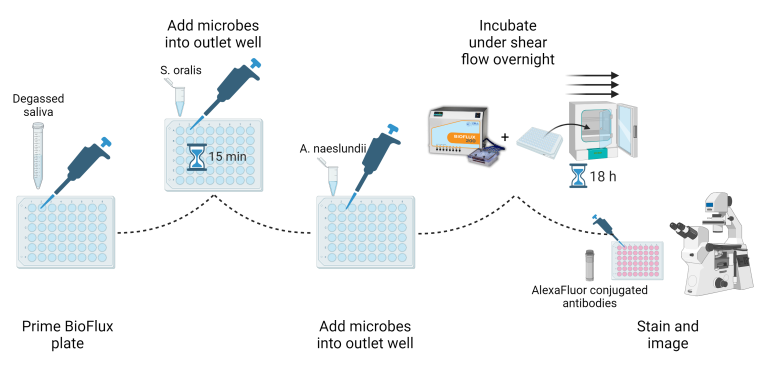
Oral biofilm imaging using BioFlux
Interspecies competition in oral biofilms mediated by Streptococcus gordonii extracellular deoxyribonuclease SsnA
Real-time inhibition of a mixed-species microcosm biofilmA structured microbial community attached to a surface, typically more tolerant to antibiotics/biocides than planktonic cells. by NucB under saliva flow. 24-well BioFlux plates were used to create a dual microenvironment to examine control and experimental conditions in the same microfluidic channelMicron-scale channels that enable controlled flow, gradients, and imaging in small volumes; central to BioFlux plate architecture..
Fluorescent nanosensors reveal dynamic pH gradients during biofilm formation
A video of 22 hour time-lapse imaging of Pseudomonas aeruginosa acidification during biofilm formation, reported by fluorescent nanosensors. Red indicates low pH, whereas green indicates higher pH values.
Polymicrobial Aggregates in Human Saliva Build the Oral Biofilm
A video of time-lapse imaging of biofilm growth from saliva inoculum on a BioFlux microfluidic channel coated with hydroxyapatite to mimic the surface of a tooth.
The consistent application of hydrogen peroxide controls biofilm growth and removes Vermamoeba vermiformis from multi-kingdom in-vitro dental unit water biofilms
Real-time video of the partial removal of biofilm layers due to the application of hydrogen peroxide. Cysts initially shrink (darkening) and eventually swell and lyse.

Key BioFlux Advantages For Oral Biofilm Studies
- Accelerate oral biofilm investigations with up to 24 experiment per plate throughput
- BioFlux does not require the use of artificial media or defined species during any point of the experiment
- Mimic the flowing conditions that occur in the human oral cavity, including pH, temperature, and shear stress
- Microfluidic channels have lower saliva requirements compared to larger systems, such as flowcells or constant depth film fermentors (CDFFs)
- Analyze both short and long-term effects of substances on biofilms as well as supply fresh nutrients by utilizing continuous flow
- Visualize and analyze the impact of anti-biofilm and antimicrobial substances on biofilms to study antibiotic tolerance and susceptibility


Featured Article
The consistent application of hydrogen peroxide controls biofilm growth and removes Vermamoeba vermiformis from multi-kingdom in-vitro dental unit water biofilms
Water systems within a dental unit are often contaminated with biofilms from multiple kingdoms, including bacteria, fungi, viruses, and protozoa. If these microorganisms become aerosolized, both patients and dental staff may become infected with potentially harmful pathogens.
In this recently published featured article, Hoogenkamp et al. examined the effectiveness of multiple treatment regimens using hydrogen peroxide with Oxygenal to disinfect dental units. To determine the most effective regimen, a BioFlux cellular analysis system was used to construct a translational in-vitro dynamic flow model to simulate multi-kingdom biofilms on dental unit water systems.
FAQs:
Oral Biofilm Formation and Microbial Adhesion Using BioFlux
What is the best in vitro model for studying oral biofilm formation under flow conditions?
The BioFlux System provides a microfluidic platform that mimics salivary flow and shear stressThe tangential force per unit area from flowing fluid; a key parameter in vascular biology, platelet function, leukocyte rolling, and biofilm adhesion studies., making it ideal for modeling oral biofilm development. It supports real-time imaging and controlled environmental conditions for studying microbial adhesion, growth, and biofilm maturation.
How can I study microbial adhesion and biofilm formation of oral pathogens?
The BioFlux enables researchers to perfuse oral bacteria such as Streptococcus mutans, Porphyromonas gingivalis, or mixed-species communities over microfluidic surfaces under flow. This setup allows for reproducible oral biofilm assays that reflect oral cavity dynamics.
What microfluidic system supports live imaging of oral biofilms?
The BioFlux integrates with fluorescence and phase contrast microscopy supporting high resolution imaging of biofilm formation, structure, and detachment under flow conditions in real time.
Can the BioFlux be used to study multispecies oral biofilms?
Yes, the BioFlux is well-suited for modeling multispecies biofilms. Its controlled flow environment supports co-culture of oral microbes, enabling studies of microbial interactions, competitive adhesion, and synergistic biofilm development.
What are the advantages of using the BioFlux over static biofilm assays?
The BioFlux replicates the dynamic flow conditions of the oral cavity, which are critical for accurate biofilm modeling. Unlike static assays, it allows for controlled shear stress, nutrient flow, and real-time observation of biofilm growth and dispersal.
How does the BioFlux support multi-condition oral biofilm experiments?
The BioFlux offers well plate formats with 3, 8, and 24 microfluidic channels, allowing the testing of multiple experimental conditions. This enables comparative studies of surface coatings, antimicrobial treatments, and microbial strains under shear flow.
What substrates can be used to coat the microfluidic channels of BioFlux plates in oral biofilm studies?
The microfluidic channels of BioFlux plates can be coated with various bio-compatible substrates that mimic tooth or mucosal surfaces. This supports targeted studies of microbial adhesion and biofilm formation on oral-relevant materials.
Is the BioFlux compatible with anaerobic oral bacteria?
Yes, the BioFlux can be used to study the growth of anaerobic oral pathogens. Its design allows for the delivery of gas conditions that support the growth of anaerobic or aerobic pathogens.


