Generating monoclonal colonies is a fundamental step in cell biology research, allowing researchers to study individual cells and their unique characteristics. However, misconceptions and challenges have surrounded this process for years. Fortunately, CellRaft® Technology has emerged as a revolutionary solution, debunking these myths and transforming the way monoclonal colonies are generated. In this blog post, we will explore the top 10 myths associated with generating monoclonal colonies and how CellRaftA microscale polystyrene growth surface within an array used to spatially segregate cells/colonies while maintaining shared media access, enabling imaging over time and targeted isolation. Technology shatters these barriers, paving the way for more efficient and reliable research.

CellRaft Technology streamlines the process of generating monoclonal colonies by enabling high-throughput single-cell isolation and culture, reducing time and labor required.

CellRaft Technology optimizes resource utilization by isolating and culturing thousands of individual cells on arrays made up of thousands of microwells that allow cells to be spatially separated while sharing media, minimizing the need for excessive media and plasticware.
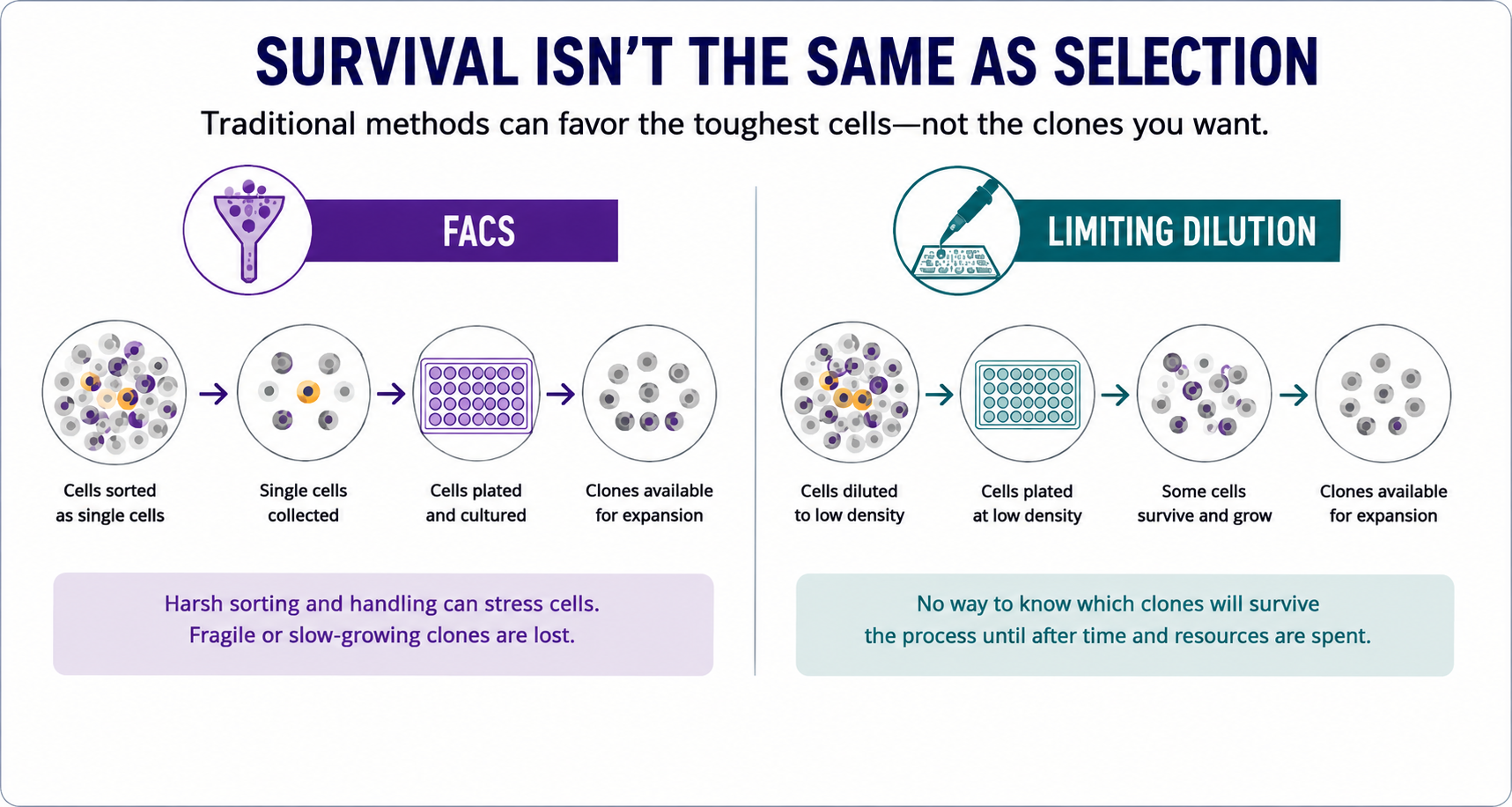
CellRaft Technology ensures high cloning efficiency by providing a gentle and non-invasive method of isolating single cells, minimizing stress, and preserving cell viability.

CellRaft Technology enables the imaging of cells from the single cell stage to the colony stage to provide a record of growth.
CellRaft Technology offers a standardized and automated approach, reducing subjective interpretation and minimizing human error.

CellRaft Technology preserves high cell viability during subcloning by providing a gentle and controlled environment for isolation, without using fluidics.
CellRaft Technology incorporates traceability features, allowing researchers to easily track and document the lineage of monoclonal colonies, ensuring reproducibility and data integrity.

CellRaft Technology enables high-throughput single-cell isolation and culture, facilitating the generation of large numbers of monoclonal colonies with scalability and efficiency.

CellRaft Technology excels in identifying and isolating rare cell populations, enabling their characterization and downstream analysis with ease.
CellRaft Technology simplifies the process of generating monoclonal colonies, making it accessible to researchers with varying levels of expertise and reducing the need for specialized skills.
CellRaft Technology has revolutionized the field of generating monoclonal colonies by dispelling the myths and limitations that have hindered this process for years. By offering high-throughput single-cell isolation, optimizing resource utilization, and simplifying workflows, CellRaft Technology empowers researchers to generate monoclonal colonies with enhanced efficiency, reproducibility, and scalability. Embrace the possibilities that CellRaft Technology brings, and unlock new avenues of discovery in cell biology research. Say goodbye to myths and welcome a new era of reliable and impactful research.


Dr. Jessica Hartman has a B.S in Biology from the University of Virginia, a Ph.D. from Duke University in Molecular Cancer Biology and postdoctoral training in Biochemistry and Cancer Biology at Baylor College of Medicine and Duke University, respectively. She has previously served in Director-level roles, managing bioscience research and development for biotechnology companies. At Cell Microsystems, Dr. Hartman’s role is to lead the development of new and streamlined workflows using the CellRaft Technology and its associated products.