Antibody Applications
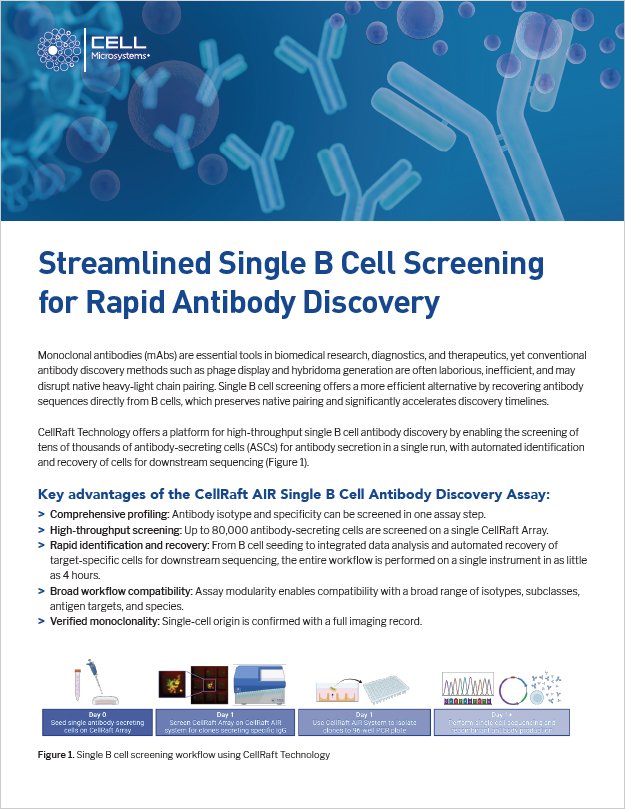
CellRaft Technology: Forward Screening for Antibody Discovery
CellRaft Technology flips the traditional funnel. Instead of screening blind, it allows you to:
- Detect antibody secretion and specificity directly on-array
- Screen tens of thousands of individual cells in one compact consumable
- Isolate only the clones that matterābefore spending time downstream
Why Antibody Discovery Needs a New Approach
From research tools to FDA-approved therapeutics, antibodies have revolutionized science and medicine. Yet the road from immunization to validated antibody is long and full of bottlenecksāespecially in the early discovery stages.
- Hybridoma screening is labor-intensive and prone to genetic drift.
- B-cell sequencing is expensive and provides no early functional readout.
- Recombinant antibody generation is limited by the ability to generate high-titer stable monoclonal cell lines.
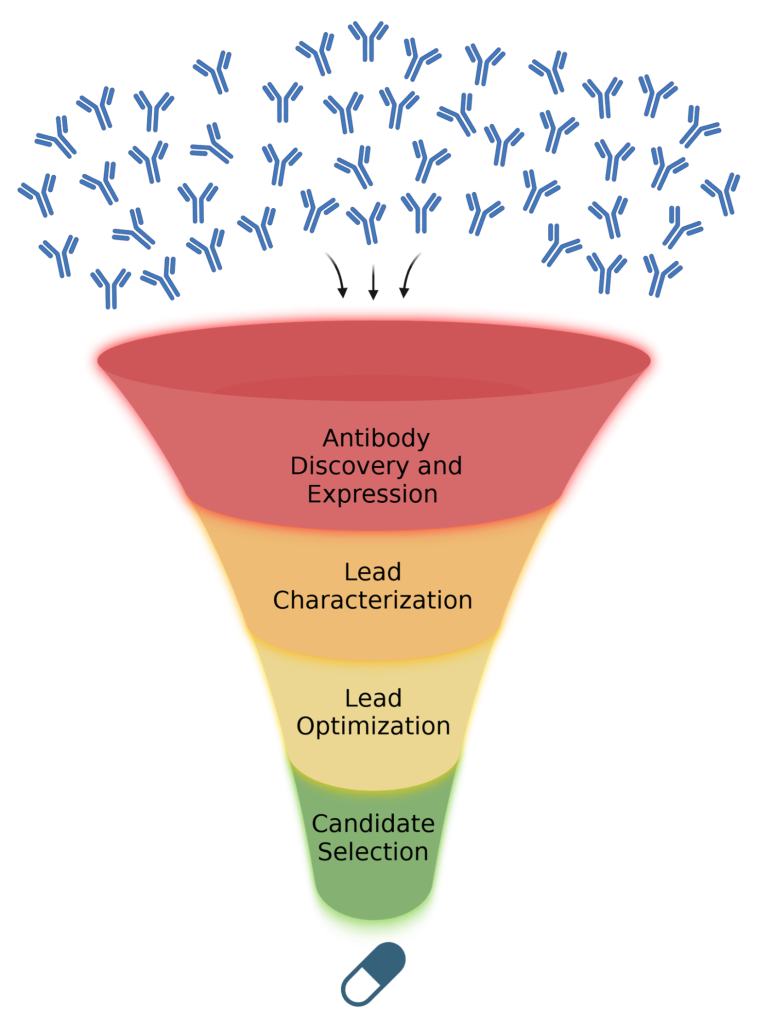
Applications Across the Antibody Discovery Pipeline
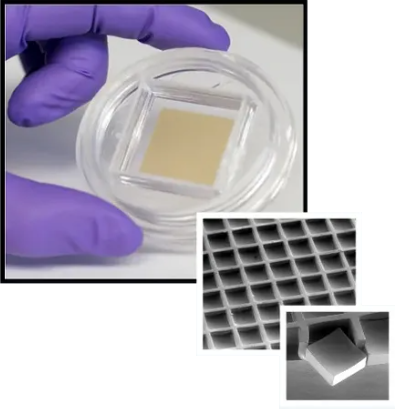
Skip the sequencing-first approach. Use CellRaftA microscale polystyrene growth surface within an array used to spatially segregate cells/colonies while maintaining shared media access, enabling imaging over time and targeted isolation. AIR to identify and isolate antigen-specific B cells upfront.
In partnership with Duke University, Cell Microsystems screened 250,000 primary mouse plasma cells to identify antigen-specific target sequences.Ā Recombinant antibodies produced from these sequences yielded specificity equivalent to commercial antibodies.
Key Benefits:
- Screen tens of thousands of rare, non-dividing plasma cells
- Identify antigen-specific sequences before investing in expression vectors
- Reduce sequencing costs by enriching for functional hits first
- Screen tens of thousands of rare, non-dividing plasma cells
- Identify antigen-specific sequences before investing in expression vectors
- Reduce sequencing costs by enriching for functional hits first
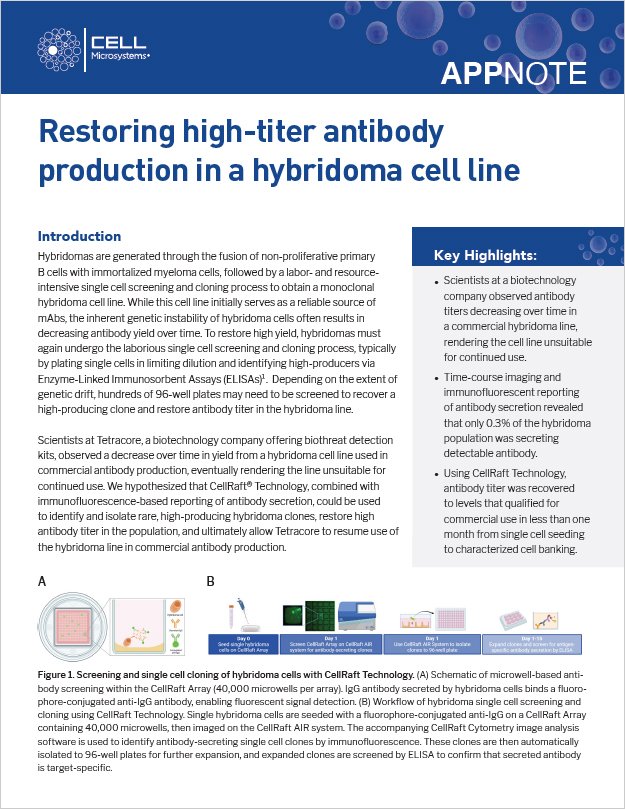
Recover lost productivity from poor producing or unstable clones. In a collaboration with Tetracore, the AIR System was used to recover high-producing clones from a population where only 0.1% of cells were still antibody producing. All recovered clones produced >10x more antibody than the parental line and restored functionality to a discontinued commercial kit.
Key Benefits:
- Detect rare antibody producers (<0.1% of population)
- Avoid drifted clones
- Validate secretion before expansion
Hybridoma Screening Workflow
When expression doesnāt guarantee function, use CellRaft AIR to find your best producers early. Even in stably transduced, flow cytometry enriched cells, only a fraction actually secrete antibodies suitable for scale.
Key Benefits:
- Evaluate productivity of polyclonal populations and derive monoclonal production cell lines
- Select top performers based on secretion, not just transfection markers
- Avoid expanding non-functional clones
Recombinant Antibody Producer Selection Workflow
Advantages at a Glance
Ensuring cells undergoing gene editing grow into clonal colonies is an essential component of the editing workflow. Using the CellRaft AIRĀ® system, single cells can be imaged and tracked over the course of colony formation. In addition, the knockout phenotypes (elimination of GFP and RFP signal) can be tracked over time which provides a unique capability for phenotypic gene editing screening.
Feature | Traditional Methods | CellRaftA microscale polystyrene growth surface within an array used to spatially segregate cells/colonies while maintaining shared media access, enabling imaging over time and targeted isolation. AIR System |
|---|---|---|
Throughput | 1,000 cells per 10 plates | 40,000 cells per array |
Function-first screening | ā | ā
|
Clonal tracking | ā | ā
|
Media usage | ~4,000 mL for 10 plates | ~3 mL per array |
Hands-on time | Dozens of hours | ~21 hours total per campaign |
Scale flexibility | Limited | Scalable from 1 to 10+ arrays |
Want to Start Faster? Weāll Do It for You.
Our applications team offers lab services to help you:
- Rescue clones
- Screen hybridomas or plasma cells
- Develop custom antibody-expressing lines
When you’re ready, weāll help you bring the workflow in-house with full training and support.
Antibody Applications FAQs
How can I screen antibody-secreting cells at single-cell resolution without damaging them?
Conventional screening of antibody-secreting cells often involves isolation of single cells by limiting dilutionA statistical cloning approach where cells are diluted to low density to āhopefullyā seed one cell per well; commonly used but can be low-efficiency for difficult-to-clone lines. or FACS, followed by ELISA-based identification of productive clones. This workflow is inherently low-throughput and damaging to cells, and often fails to capture rare populations.
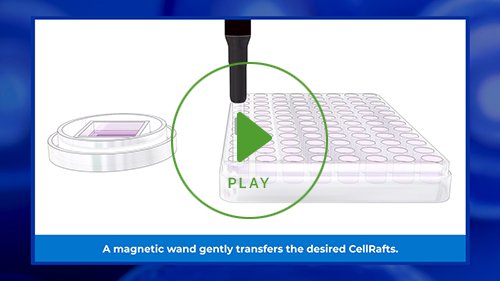
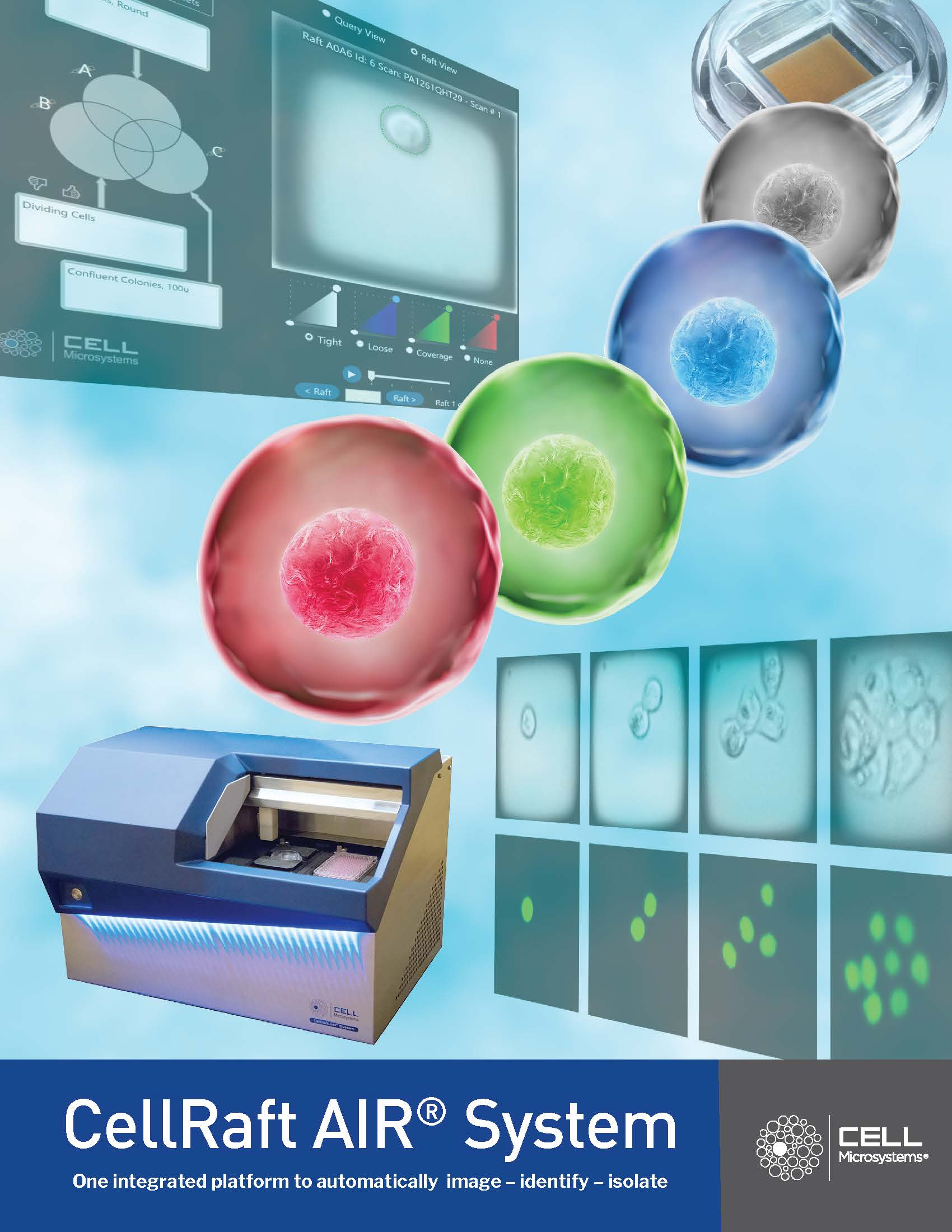
The CellRaft AIR systemAn all-in-one platform for imaging, identifying, and isolating viable single cells, colonies, or organoids using CellRaft Arrays and software-guided selection with CellRaft Cytometry. combines rapid, high-throughput screening of tens of thousands of antibody-secreting cells on a single microwell array (CellRaft ArrayConsumables containing thousands of microwells (containing CellRafts) for spatial segregation, imaging, and isolation of single cells, monoclonal colonies, or 3D cultures.) with software-guided identification and gentle recovery of desired cells. This allows researchers to detect and recover productive clones without compromising cell viability.
What is the best method to identify high-producing hybridoma clones early?
Many hybridoma campaigns waste time expanding clones that never achieve desirable titers.
The CellRaft AIR platform solves this by measuring antibody secretion directly from individual hybridoma cells early in the hybridoma generation process. Only the top-performing clones are isolated and expanded, reducing time, consumables, and false-starts.
How can I isolate rare antigen-specific B cells efficiently?
Antigen-specific B cells often comprise <0.1% of the B cell population and are easily lost when screening single cells in plates.
The CellRaft AIR enables fluorescent-based detection of both isotype and antigen-specificity, enabling rapid, real-time screening of tens of thousands of B cells on a single microwell array (CellRaft Array) and recovery of rare plasma B cell populations.
How do I screen and isolate plasma cells that donāt survive flow sorting?
Plasma cells are fragile and short-lived and are thus poorly suited to FACS workflows.
The CellRaft AIR keeps plasma cells in place for screening of target-specific antibody secretion, followed by gentle transfer of productive single cells to PCR plates or tubes for molecular analysis. This maintains high viability of plasma cells and improves recovery of antibody sequences.
How do I confirm monoclonality in antibody-producing cell lines?
Many single cell cloning workflows rely on limiting dilution statistics rather than visual proof of monoclonalityEvidence that a colony/line originated from one cell; often supported by time-course imaging and traceability..
The CellRaft AIR system tracks clones from a single cell with time-stamped images. This provides image-based proof of monoclonality and simplifies documentation for regulatory submission.
How can I find high-titer recombinant antibody-producing clones faster?
Workflows for single cell cloning of recombinant antibody-producing cells often expand large numbers of cells before knowing which cells produce the most antibody.
With CellRaft AIR, researchers measure secretion at the single cell level first, then recover only the highest-producing clones for expansion. This function-first approach increases the likelihood of capturing rare, high-titer producers while reducing time, labor, and consumable use.
How do I detect antigen specificity and secretion in the same screen?
On many platforms, antibody isotype and specificity are screened separately.
The CellRaft AIR uses fluorescent capture reagents to report antibody isotype and antigen binding simultaneously at the single cell level, letting you prioritize functional, target-specific clones.
How do I shorten antibody discovery timelines and lower consumable costs?
Many antibody discovery workflows rely on screening single cells in 96- or 384-well plates, a highly laborious and low-throughput method.
With the CellRaft AIR, functional screening of tens of thousands of single cells can be performed on a single microwell array (CellRaft Array), which reduces plate usage, media consumption, and hands-on time. The result is faster selection of high-value, target-specific clones.
Antibody Applications FAQs
Ready to accelerate your antibody workflows with forward screening?
scroll