Antimicrobial Screening
Visualize & Quantify Antimicrobial Investigations
Antimicrobial screening often requires the assessment of many compounds under near identical conditions. This makes the use of microplates popular, however, biofilms grown under static conditions are often malnourished and underdeveloped. This can lead to false positive results. positives without sacrificing throughput.
BioFlux shear flow systems can accommodate up to 24 experiments in parallel, under biologically relevant conditions. This enables the acceleration of antimicrobial discoveries by reducing false positives without sacrificing throughput.
BioFlux antimicrobial screening workflow

Antimicrobial investigations using BioFlux
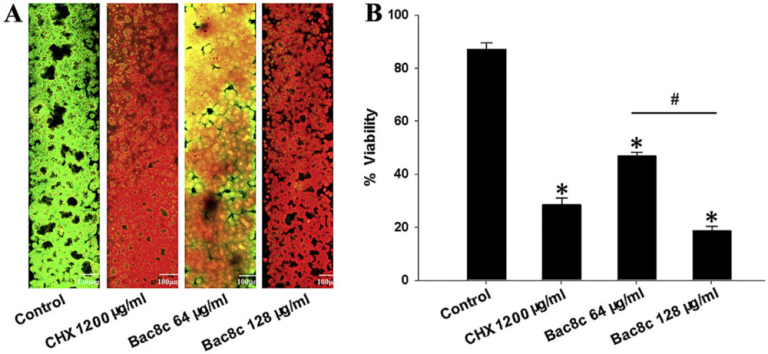
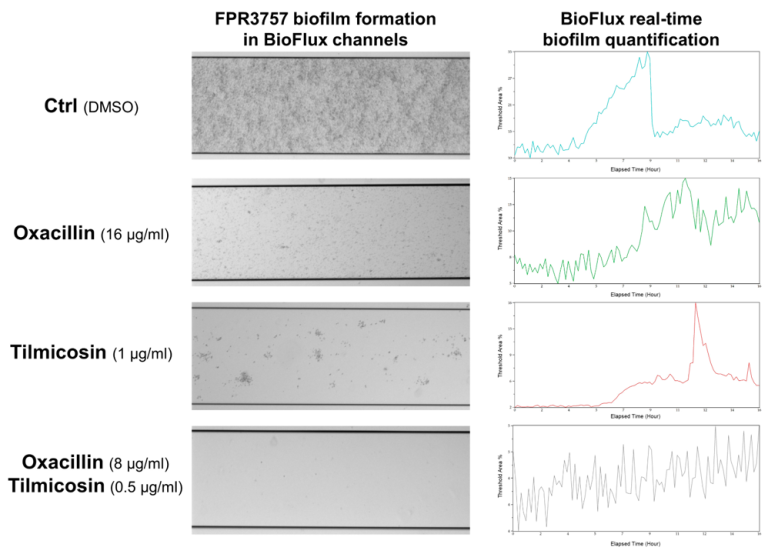
Poster spotlight: Growing Mature Biofilms for Antimicrobial Screening, Host-pathogen Interactions, and Adhesion

Key BioFlux Advantages For Antimicrobial Screening Studies
- Analyze the effectiveness of different antimicrobial compounds by growing biofilms under controlled shear flow, mimicking the conditions of natural growth
- Use the all silicone plate format for antimicrobial compounds relating to catheter-associated infections
- Custom substrate plates feature the ability to add any material to the bottom of microfluidic flow chambers, and enable a full range of experimental protocols for a variety of microbes and antimicrobial compounds
- Discover new antimicrobial compounds and help eradicate antibiotic tolerance and susceptibility with a flow-based system
Maximize Screening Throughput with BioFlux 1000HT

BioFlux 1000HT includes:
- Customizable microscope
- Automated stage
- Compatibility with 6, 24, and 48-well BioFlux plates
- Dual gas & Optional temperature control
- Montage Plus acquisition and analysis software
- Automated image acquisition using a BioFlux 1000z
Article Highlight
In Silico Screening and In Vitro Assessment of Natural Products with Anti-Virulence Activity against Helicobacter pylori
Helicobacter pylori is one of the most frequently encountered human pathogens. Infection with H. pylori can lead to the development of various gastric diseases, such as peptic ulcers and gastric cancers.
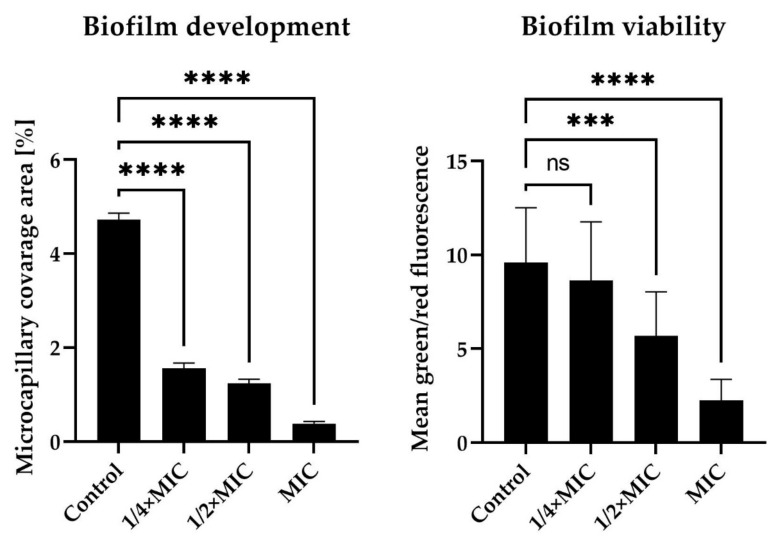
In this article, Spiegel et al. virtually screened 791 natural substances for anti-biofilm activity. To find the most effective antimicrobial substance, the group leveraged the high throughput capacity of the BioFlux 1000Z to test the 10 top candidates under physiological flow and no flow environments.
FAQs:
Antimicrobial Screening Using the BioFlux
What is antimicrobial screening and why is it important for biofilm research?
Antimicrobial screening identifies compounds that inhibit or eradicate microorganisms, especially those in biofilms—structured multicellular communities resistant to traditional antimicrobials. Biofilms grown in static microplate assays are often immature and nutritionally limited, leading to false positives. Physiology-relevant screening is essential for discovering effective antimicrobial agents.
How does shear flow affect biofilm formation during antimicrobial testing?
In vivo, biofilms develop under continuous fluid shear—something static assays fail to replicate. Shear flowFluid movement that applies force to cells and biofilms; used to mimic physiological/pathological conditions. alters biofilmA structured microbial community attached to a surface, typically more tolerant to antibiotics/biocides than planktonic cells. architecture, nutrient gradients, and drug penetration. Shear flow systems, like the BioFlux, emulate physiological conditions by controlling shear flow rates, thus producing mature, structurally accurate biofilms more reflective of natural infection interfaces
What distinguishes BioFlux microfluidics from traditional microplate antimicrobial assays?
The BioFlux employs well-plate integrated microfluidic channels that enable the delivery of precise, programmable shear flow, dual-gas, and temperature control. This automation accelerates data acquisition and reduces false positives relative to conventional static microplate methods.
Can the BioFlux enhance throughput for antimicrobial compound screening under shear flow?
Yes. Systems like the BioFlux integrate automated microscopy with microfluidics embedded in standard well-plate formats (6-, 24-, 48-well) that enable live imaging of multiple antimicrobial assays—optimizing throughput without sacrificing physiological relevance.
How does the BioFlux enable quantitative real-time measures of antimicrobial efficacy?
The pairing of the BioFlux with an inverted microscope, enables real-time visualization of biofilm responses to antimicrobial compounds using live/dead fluorescent stains. This setup allows monitoring cell viability dynamically within the microfluidic channels in BioFlux plates. Integrated imaging software, such as Montage Plus, quantifies biomass and fluorescence intensity over time, providing statistically robust comparisons between treated and control biofilms under shear flow conditions.
Which pathogens have been studied using the BioFlux for antimicrobial testing?
The BioFlux has been used to study Streptococcus mutans, MRSA USA300, Helicobacter pylori, Pseudomonas aeruginosa, Acinetobacter baumannii, among others. These studies include both static and shear flow comparisons, revealing the system’s versatility across Gram-positive and Gram-negative ‑biofilms.
Is the BioFlux compatible with live cell imaging and microplate workflows?
Absolutely. BioFlux plates contain microfluidic channels that are embedded in between SBS-standard well-plates and coverslip-glass bottoms. They integrate seamlessly with inverted microscopes (BioFlux 200+ compatible) or offer a turnkey setup (BioFlux 1000HT) for high-resolution, automated imaging.
Can the BioFlux help reduce false positives in antimicrobial screening?
Yes. By replicating physiological shearFlow conditions intended to resemble those in vivo (e.g., vasculature, catheters, mucosal surfaces). flow, the BioFlux allows the growth of more mature and robust biofilms. This reduces non-specific compound hits common in static assays, enhancing the predictive validity of hits for downstream in vivo testing.