Gene Editing is Hard, but Finding the Edited Cells Doesn’t Have to Be
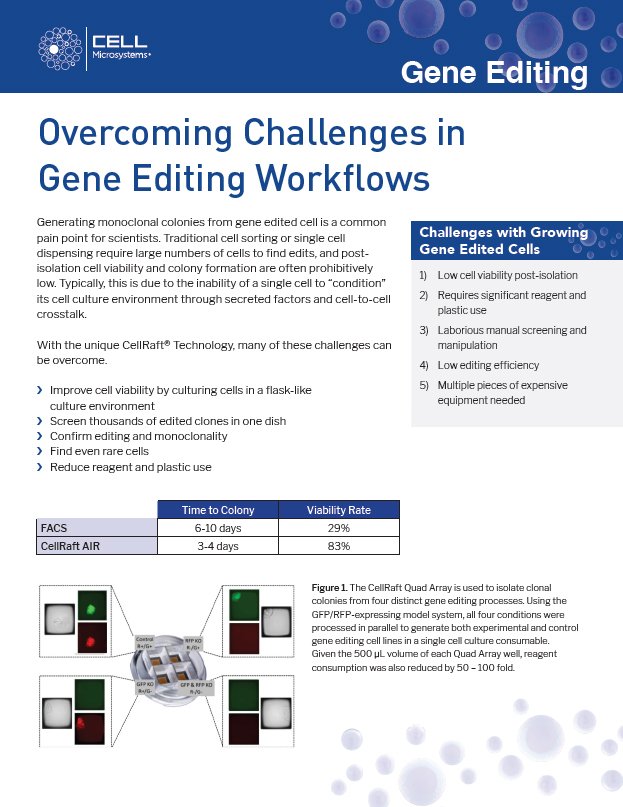
Gene editing holds tremendous promise for advancing medical research, but isolating viable, edited monoclonal colonies can be a roadblock. For researchers facing challenges growing cells post-editing, these obstacles can delay insights and experimental success.
CellRaft Technology will help you overcome these limitations, transforming your approach to forming and growing colonies with the edits you want.
How CellRaft Technology Overcomes These Challenges
Increase Your Yield of Viable Monoclonal Colonies with Ease by:
Improving monoclonal colony formation from fragile edited cells.
Using a single consumable that enables screening thousands of cells for the edits you want via automated image acquisition and software-driven analysis.
Isolating cells using our innovative and gentle, fluidics-free approach.
How We’re Different:
Our proprietary consumable enables superior single cell growth by allowing cells to share media while remaining physically isolated, unlike traditional single-cell-per-well methods.
We pick colonies, not single cells, so the 96 well plates are filled with viable clones that continue to expand rapidly.
We can identify even rare edits from minimal cell inputs that are not feasible in fluidics-based instrumentation.
We offer the ability to screen 40,000 cells (equivalent to 416 96-well plates).
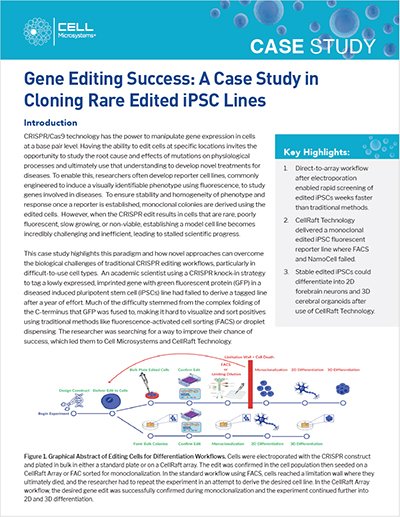
See How Kite Pharma Accelerated Their Cell Line Development for Gene-edited Cells
Accelerating Generation of Single Cell Clones by Using a CellRaftA microscale polystyrene growth surface within an array used to spatially segregate cells/colonies while maintaining shared media access, enabling imaging over time and targeted isolation. AIR® System Coupled with Fluorescence Activated Cell Sorting
Single cells are seeded on the CellRaft ArrayConsumables containing thousands of microwells (containing CellRafts) for spatial segregation, imaging, and isolation of single cells, monoclonal colonies, or 3D cultures. after introducing transgenic or CRISPR/CAS9 elements. This eliminates the need for trypsin, scraping, high-pressure fluidics, or limiting dilutionA statistical cloning approach where cells are diluted to low density to “hopefully” seed one cell per well; commonly used but can be low-efficiency for difficult-to-clone lines.. The CellRaft Array is made up of thousands of microwells called CellRafts that allow the cells to share a contiguous media volume so that while the cells are segregated, they are not “alone.”
Image CellRafts at Multiple Time Points
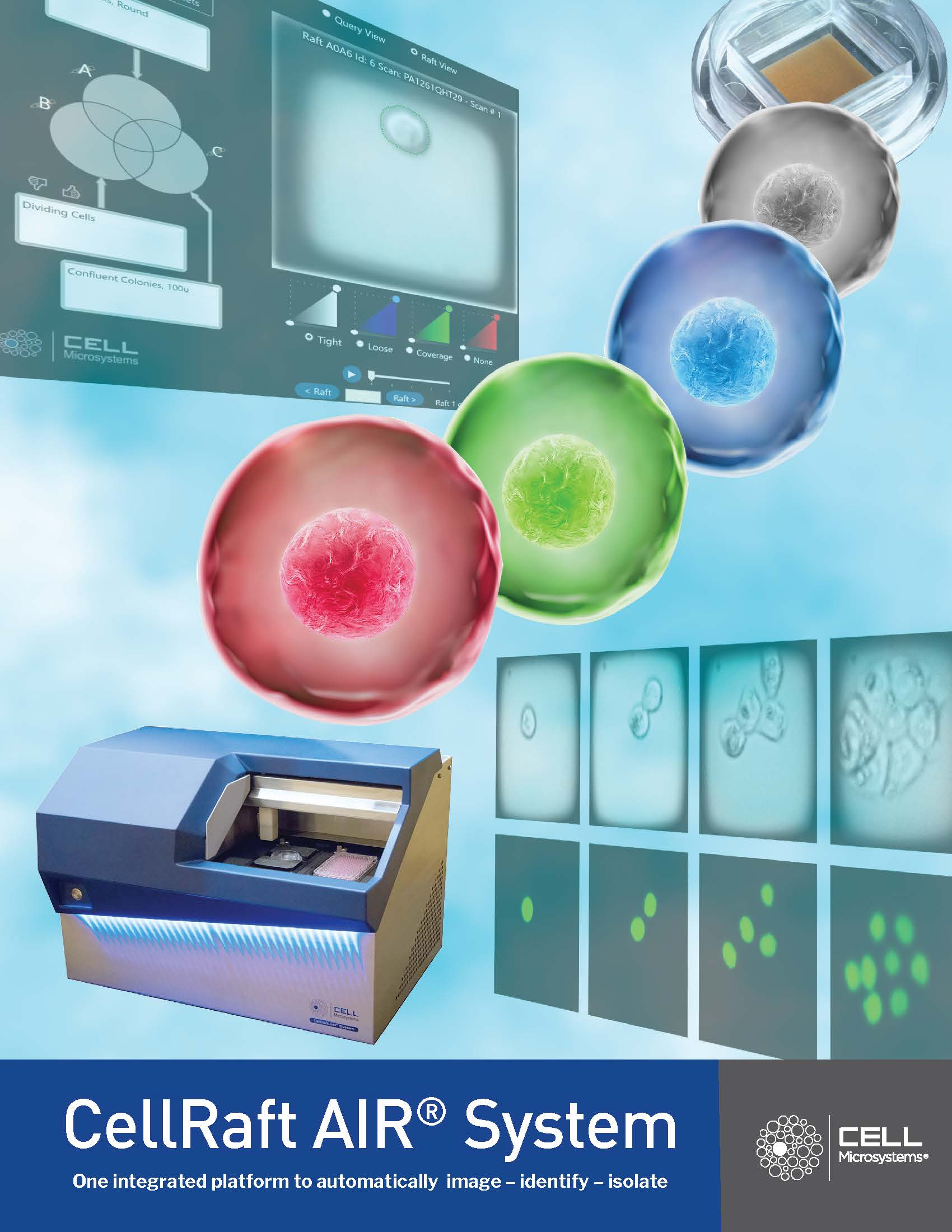
Ensuring cells undergoing gene editing grow into clonal colonies is an essential component of the editing workflow. Using the CellRaft AIR® system, single cells can be imaged and tracked over the course of colony formation. In addition, the knockout phenotypes (elimination of GFP and RFP signal) can be tracked over time which provides a unique capability for phenotypic gene editing screening.
Cells transfected with a GFP-expressing plasmid were tracked for the growth of clonal colonies.
Software-guided Identification and Automated Isolation of Cells of Interest
CellRaft Cytometry™ software allows for image-based verification of single cells to ensure monoclonalityEvidence that a colony/line originated from one cell; often supported by time-course imaging and traceability. and analysis of a variety of parameters over time, ranging from size to morphology to gene expression. Users can easily define the characteristics of the target cells or colonies and map them for software-guided CellRaft selection and automated isolation by the CellRaft AIR SystemAn all-in-one platform for imaging, identifying, and isolating viable single cells, colonies, or organoids using CellRaft Arrays and software-guided selection with CellRaft Cytometry..