As my mother, a seasoned scientist and lab veteran who has trained countless students and post-docs, likes to say, “They don’t call it RE-search for nothing. It’s because we RE-do experiments over and over again until it works.” So, it should come as no surprise that she cautioned me to think long and hard about becoming a career researcher.
In the folly of my youth, I didn’t listen, and as mothers tend to be, it turns out she was completely right. Day after day, scientists show up to the lab striving to achieve the impossible. Despite long hours, grueling experiments, and weeks or months of failure, we persevere, hoping for that elusive breakthrough that can impact human health. Yet sometimes, despite our best efforts, flawless experimental designs, and meticulous lab work, our tools fall short, leaving us to RE-peat our labors.
It is our keen understanding of this frustration that drove us to launch our “Clone Challenge”. Our aim was simple: provide struggling scientists access to novel technology that could solve the bottleneck inhibiting their progress. Our first clone challenge winner came to us from Stanford University. We were excited by the complexity of the problem and the opportunity to help.
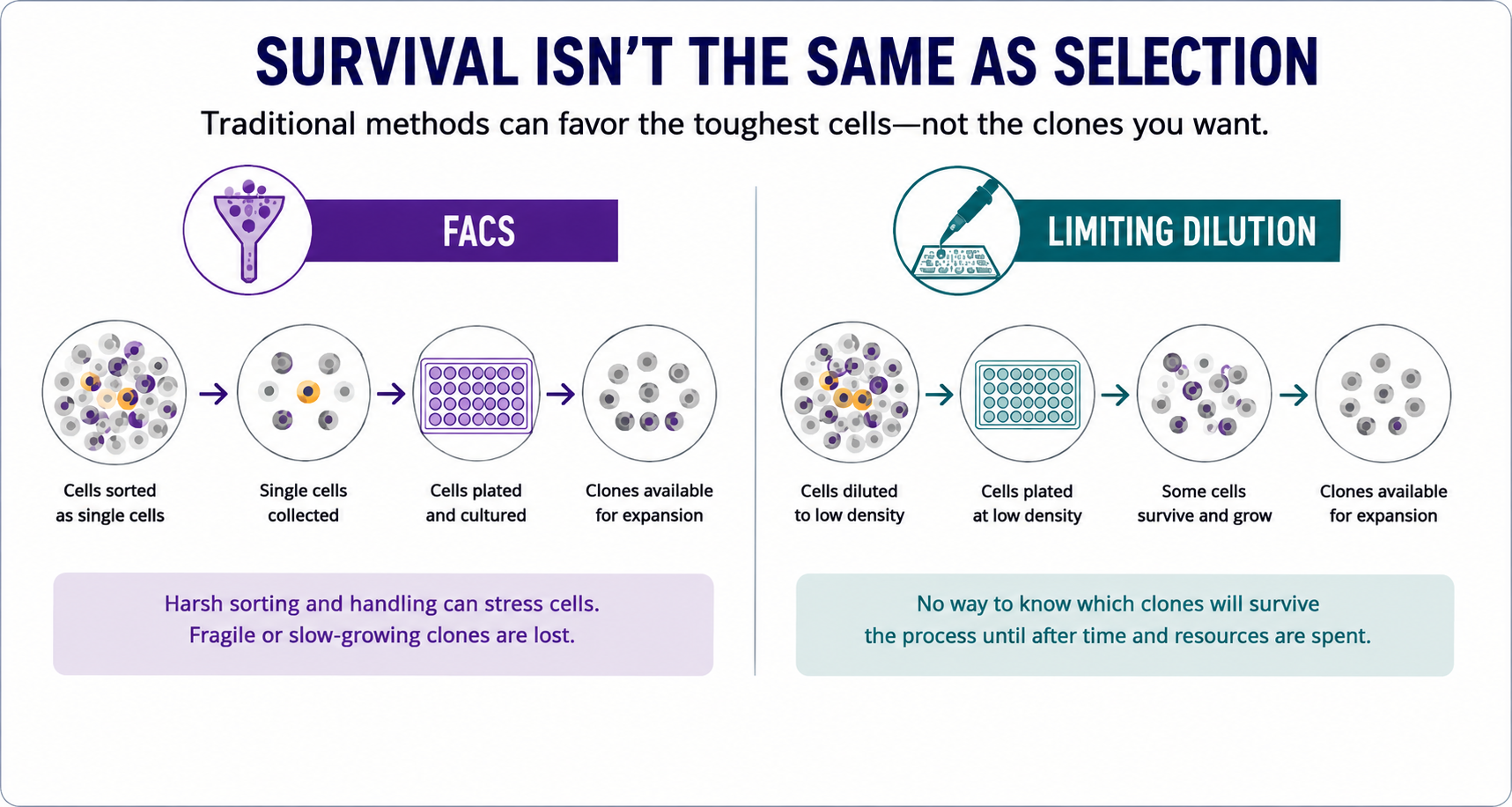
In their application, the Stanford team explained that they were using a human glioblastoma cell line (the most malignant adult brain cancer type), which must be cultured in suspension as spheroids to prevent differentiation. However, as is often the case, the cell line is not homogenous, and approximately 90% of the population has one type of genetic amplification, while 10% of the population has a different genetic amplification of the same gene. For months, they had been attempting to derive clonal populations of these two genotypes without success, as these cells do not grow well as single cells. Moreover, the screening necessary to confirm the genotypes was labor-intensive, expensive, and not easily scalable.
The team at Stanford provided us with their cell line, and we used CellRaftA microscale polystyrene growth surface within an array used to spatially segregate cells/colonies while maintaining shared media access, enabling imaging over time and targeted isolation. Technology to derive monoclonal cell lines from the bulk parental line. Although the initial promise of the clone challenge was five monoclonal cell lines, due to the low frequency (1 in 10) of one of the genotypes, we realized we needed to screen as many as possible. Over the course of about six weeks, we generated clonal cell lines that maintained their ability to grow as spheroids (see below). Upon returning the clones to Stanford, they validated that 26 of the lines were correct, and they were able to obtain isogenic matched pairs with both genotypes after confirmation with their orthogonal methods.
As a scientist who has failed in the lab all too often, the response from the team at Stanford was profoundly gratifying:
“Thank you so much for your help earlier in helping us to get monoclonally expanded cells. We are all very happy with the outcome as it has been quite a challenging cell system for monoclonal expansion. The clones are a great addition to the lab’s expanding cell line models.”
The moral of the story? Sometimes, you just need a little help. This is why I show up every day as a scientist at Cell Microsystems. We develop technology that enables the impossible and eliminates roadblocks. Watching fellow researchers leverage our platform to achieve breakthroughs is incredibly fulfilling. So even though mom may have been right all those years ago, I wouldn’t change a thing about my journey.

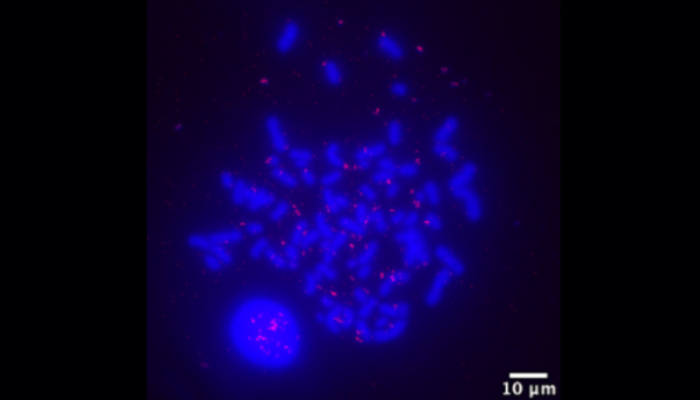
A single GBM39 cell on the CellRaft generated a monoclonal population of cells that formed spheroids in culture and demonstrated a specific genotype as measured by fluorescence in situ hybridization (FISH).


Dr. Jessica Hartman has a B.S in Biology from the University of Virginia, a Ph.D. from Duke University in Molecular Cancer Biology and postdoctoral training in Biochemistry and Cancer Biology at Baylor College of Medicine and Duke University, respectively. She has previously served in Director-level roles, managing bioscience research and development for biotechnology companies. At Cell Microsystems, Dr. Hartman’s role is to lead the development of new and streamlined workflows using the CellRaft Technology and its associated products.