You’ve done the hard part: designed your guides, nailed the edit, maybe even high-fived a teammate after confirming it worked. 🎯 But now comes the part nobody talks about enough—cloning.
You need to isolate your edited cells, expand them, and find the clones with the biology you actually care about.
Sounds simple enough.
Except there’s a catch: the clones that are best at surviving your cloning workflow aren’t necessarily the clones you want.
And when you’re working with rare edits, precise knock-ins, true knockouts, or difficult-to-grow cells, that distinction matters.
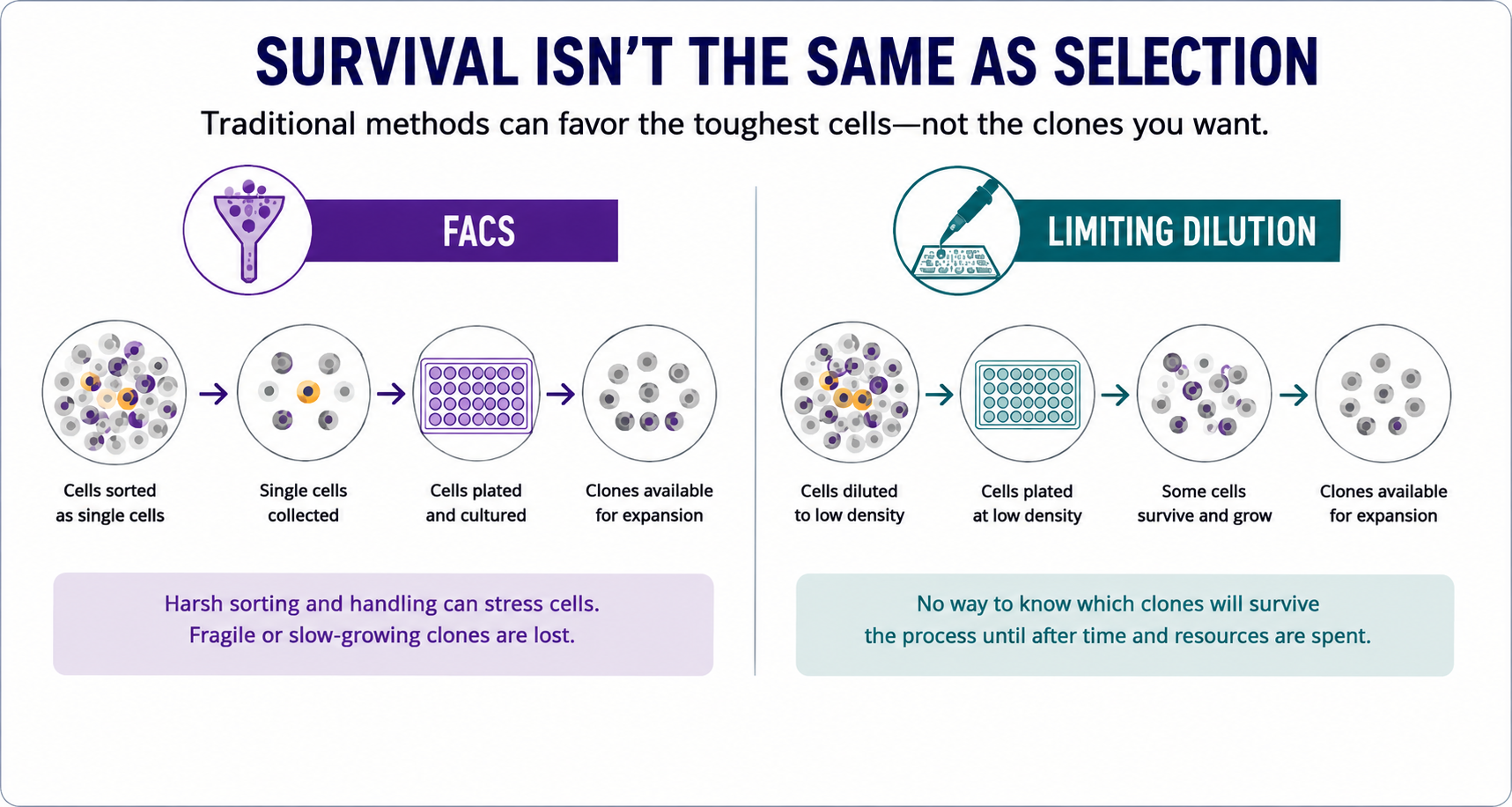
Survival Isn’t the Same as Selection
Gene editing can be stressful on cells. Some of the most interesting edited clones may grow more slowly, recover less readily, or simply be less robust than their wild-type neighbors.
That can create a problem downstream.
Traditional cloning approaches such as FACS and limiting dilution take very different routes to single-cell cloning, but both can introduce challenges for sensitive or slow-growing cells.
The result?
The clones most likely to make it through the workflow aren’t necessarily the clones you most want.
Fragile, slow-growing, or highly edited cells may drop out while hardier cells continue to expand.
So when you finally get to characterization, you may be looking at the best survivors—not necessarily the best edits.
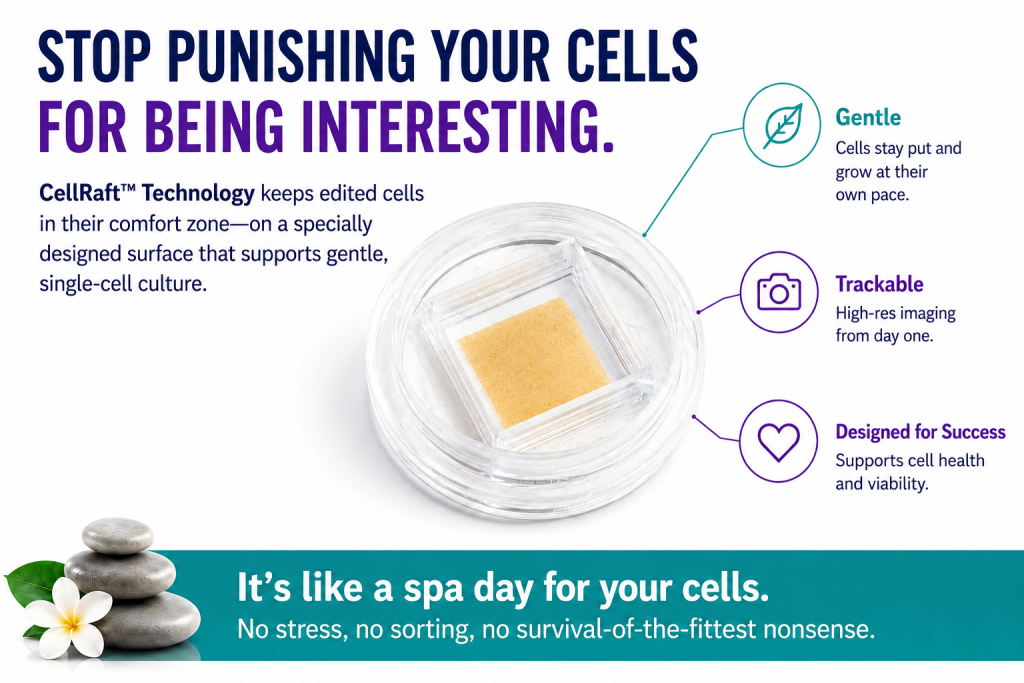
Stop Punishing Your Cells for Being Interesting
What if you could give edited cells time to show you what they can do before deciding which clones move forward?
That’s where CellRaft™ Technology changes the workflow.
Cells settle onto individual CellRafts and remain in shared culture conditions as they grow. Instead of immediately forcing cells through an isolation and transfer step, you can use high-resolution imaging to monitor individual cells as they form colonies.
It’s like spa day for your cells: no stress, no sorting, no survival-of-the-fittest nonsense.
You can see where a colony started. Track how it grows. Evaluate morphology, fluorescence, or other characteristics. Then decide which clones are worth retrieving.
In other words, you get to choose based on biology—not simply on which cells were best at surviving the cloning process.
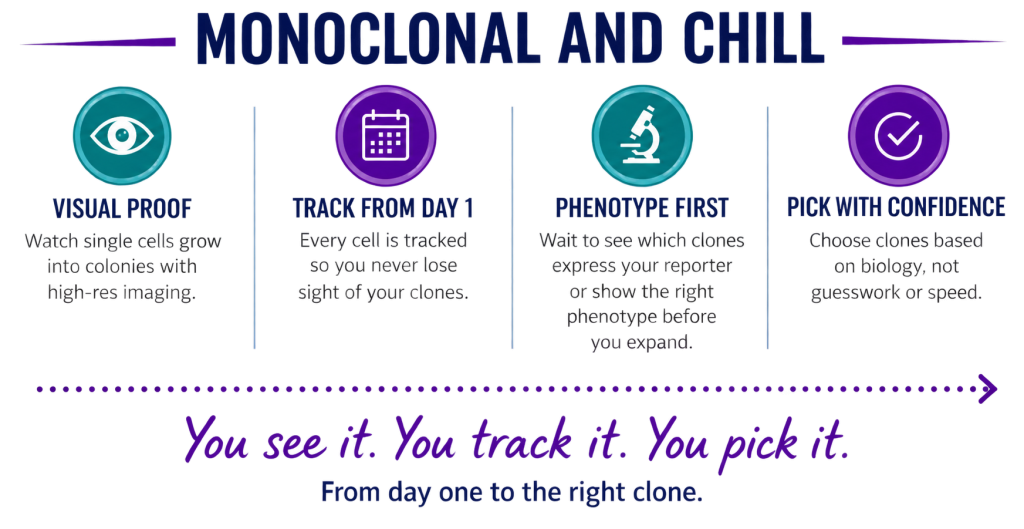
Monoclonal and Chill
Need confidence in monoclonality? Follow a single cell as it develops into a colony.
Want to know what happened between seeding and retrieval? Track your clones over time.
Looking for a particular reporter signal, morphology, or phenotype? Identify it before committing resources to expansion.
With CellRaft Technology, the workflow becomes refreshingly straightforward:
SEE IT → TRACK IT → PICK IT
Verify single-cell origin → Watch colony growth and phenotype → Retrieve the clone you want
No mystery about where the colony came from. No choosing a clone simply because it happened to grow fastest.
Just more information to help you make a better selection.
Give Interesting Clones a Chance
Your best clone might not be your fastest-growing clone.
It might be the rare one.
The slow one.
The one carrying the edit that changes its growth characteristics.
And those are exactly the cells you don’t want your cloning method deciding against before you’ve had a chance to evaluate them.
By allowing edited cells to remain in culture while you monitor colony formation and phenotype, CellRaft Technology gives promising clones an opportunity to reveal themselves before you decide which ones to retrieve and expand.
That means your selection can be driven by the biology you care about—not just survival.
Your CRISPR Workflow Is Cutting Edge. Your Cloning Platform Should Be Too.
You put a lot of work into creating the right edit. The next step shouldn’t simply be about finding the cells tough enough to make it through cloning.
It should be about finding the right clone.
CellRaft Technology combines image-based tracking, verified single-cell origin, colony monitoring, and gentle retrieval to help researchers identify and recover the clones that matter to their experiments.
Because when it comes to CRISPR cloning:
Survival of the fittest isn’t the goal. Finding the right biology is.
Ready to give your best edits a better chance?

Jessica Hartman, Ph.D.
Dr. Jessica Hartman has a B.S in Biology from the University of Virginia, a Ph.D. from Duke University in Molecular Cancer Biology and postdoctoral training in Biochemistry and Cancer Biology at Baylor College of Medicine and Duke University, respectively. She has previously served in Director-level roles, managing bioscience research and development for biotechnology companies. At Cell Microsystems, Dr. Hartman’s role is to lead the development of new and streamlined workflows using the CellRaft Technology and its associated products.

