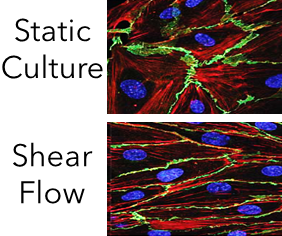
Alterations of vascular features, such as permeability, calcification, arterial remodeling, and angiogenesis play significant roles in the pathogenesis and progression of many diseases. Antiquated in vitro vascular biology assays rely on static cell cultures, which lack biological relevance.
BioFlux Shear Flow Systems enable high throughput imaging and assay of physiologically relevant vascular models.
Benefits of modeling the vasculature under shear flow
Reduced reliance on animal models
Physiological cell alignment and gene and protein expression
Mimic the hemodynamics of various areas of the vasculature
4-amino-5-methylamino-2′-7′-difluorofluorescein diacetate (DAF-FM-DA) was used to provide a direct and quantifiable measure of nitric oxide during the last hour of shear flowFluid movement that applies force to cells and biofilms; used to mimic physiological/pathological conditions. exposure. Images were taken immediately upon DAF-FM-DA addition, 1, 30 minutes, and 60 minutes after DAF-FM-DA addition. The white arrows indicate the direction of flow. Makwana et al. DOI: 10.1177/026119291704500407
Published BioFlux Applications in Vascular Biology
Publication spotlight: Role of Force-Alzheimer’s disease-associated P460L variant of EphA1 dysregulates receptor activity and blood-brain barrier function