Cell Line Development
Overcome Bottlenecks in Your Cell Line Development
Despite technological strides, critical bottlenecks persist in cell engineering, particularly in generating single-cell clones. Conventional single-cell isolation techniques, including limiting dilutionA statistical cloning approach where cells are diluted to low density to “hopefully” seed one cell per well; commonly used but can be low-efficiency for difficult-to-clone lines. and single-cell dispensing, though cost-effective, pose significant biological and technical challenges:
- Lack of viable clones
- Lack of proof of monoclonality
- Requires significant lab supplies and equipment
- Hands-on time requirements
- Limited throughput

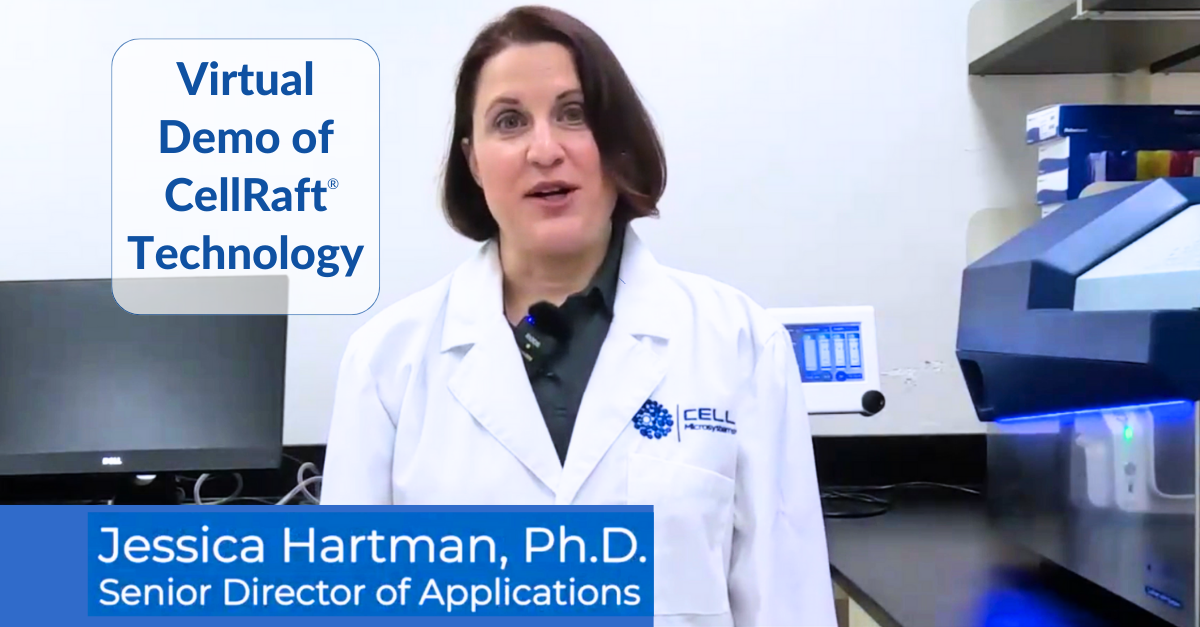
The Solution: CellRaft Technology
The CellRaftA microscale polystyrene growth surface within an array used to spatially segregate cells/colonies while maintaining shared media access, enabling imaging over time and targeted isolation. AIR® System stands out as the preferred platform for accelerating cell line generation due to its unique features, including:
- Reduced development timelines
- Seamless workflow integration
- Consolidated data for archiving and application submissions
It utilizes the CellRaft® Array, a specialized culture dish enabling the screening of thousands of cells while preserving single-cell segregation.
This approach boasts several advantages:
The absence of fluidics or pressure in the isolation process, coupled with the isolation of entire clones rather than individual cells, minimizes cellular stress and damage during the transition to the 96-well collection plates.
-
High-Throughput Screening
The capability to screen thousands of cells on a single culture dish is a significant advancement, allowing for more efficient and rapid screening. -
Monoclonality Proof
Providing track-and-trace image proof of monoclonality ensures that the cell population consists of single clones—a pivotal factor for experiments and downstream applications. Visit our Cell Atlas page to view this feature. We have tested more than 100 cell lines. -
Clonal Isolation
Isolating entire clones rather than individual single cells streamlines downstream processes and leads to higher viability outcomes. -
Flask-Like Culture Conditions
Emulating flask-like culture conditions within the CellRaft Array—where cells share media and growth factors—replicates the natural growth environment for cells. -
Gentle Clonal Isolation
The absence of fluidics or pressure in the isolation process, coupled with the isolation of entire clones rather than individual cells, minimizes cellular stress and damage during the transition to the 96-well collection plates.


The Proof
CellRaft Technology revolutionizes cell line isolation by enabling the creation of healthy, monoclonal cell lines in a cost-effective manner that surpasses the traditional Limiting Dilution method (Visit our No Limiting Dilution page). With CellRaft Technology, standard single-cell isolation workflows are completed significantly faster, reducing consumables and media requirements by over 80%.
Time-Course Imaging for Track and Traceability for Audit Trail


Increase Clone Outgrowth Efficiency

Timelines in Traditional CLD Workflow & Automation Technologies

Save Time and Reduce Costs
Experimental and cost analyses including hands-on time to run the protocol between limiting dilution and CellRaft technology indicate that the latter delivers a high return on investment in terms of outgrowth efficiency, time, and cost.

Cell Line Development FAQs
What are the main challenges in developing a stable monoclonal cell line?
Some of the core challenges include: ensuring true monoclonalityEvidence that a colony/line originated from one cell; often supported by time-course imaging and traceability. (i.e., the line originates from a single cell); maintaining cell viability during isolation; reducing manual labor and time; and verifying consistent expression of the gene of interest. The CellRaft AIR® system together with the CellRaft Array offers an integrated approach that allows time-course imaging of monoclonal proliferation from a single cell and gentle, automated isolation of clones, helping researchers overcome low efficiency, high time-cost and viability loss that are common with other isolation methods.
How can I reduce the time it takes from transfection to a clonally verified cell line?
Traditional workflows often require repeated rounds of single cell seeding, expansion and characterization, which can take many weeks or months. With CellRaft technology, researchers can seed cells on the microwell array (CellRaft Array), identify single cells, track monoclonal proliferation, and then isolate clones with minimal perturbation. This streamlined process reduces resources and hands-on labor while substantially accelerating cell line development timelines.
Why is proof of monoclonality so important and how can I achieve it?
Regulatory standards and good research practice often require that stable cell lines be derived from a single progenitor cell, especially in therapeutic or industrial protein expression contexts. Achieving proof of monoclonality means documenting that only one cell gave rise to the clonal population. The CellRaft AIR system supports this by imaging an entire microwell array, identifying which microwells (CellRafts) contain a single cell, and then tracking monoclonal growth over time, resulting in an image-based record of each clone and visual verification of monoclonality.
What are common limitations of traditional single cell cloning methods and how can these be addressed?
Traditional methods such as limiting dilution or flow sorting suffer from low single cell seeding efficiency, low cell viability, lack of clonality verification, and high consumable usage. The CellRaft workflow addresses these limitations by screening tens of thousands of single cells in shared media on a single microwell array (CellRaft Array) with image-based clonality verification and automated isolation of monoclonal colonies. This reduces cost, hands-on labor and consumable use while improving cell viability and accelerating cell line development timelines.
How do I improve the survival and outgrowth of single-cell derived clones after isolation?
Single cells often fail to proliferate when seeded alone in a well due to the absence of growth factors secreted by neighboring cells. Fluidic pressure and mechanical manipulation involved with single cell sorting can also negatively impact cell viability. The CellRaft AIR System allows single cells to proliferate in shared media on a microwell array (CellRaft Array) before transfer of intact monoclonal colonies to a well plate for further expansion. Transferring monoclonal colonies, rather than single cells, to the well plate reduces cellular stress and improves outgrowth and survival of single cell-derived clones.
Can the same workflow handle different host cell types (e.g., CHO, HEK293, iPSCs) for line development?
Yes. While many cell line development technologies focus on classic lines like CHO or HEK293 for protein expression, the CellRaft workflow is gentle enough to accommodate a wide range of cell types, including sensitive and difficult-to-culture cells like iPSCs or primary cells. Over 100 cell lines have been validated on the CellRaft AIR System.
How does automation add value to the cell line development workflow?
Automation reduces variability introduced by manual pipetting, selection bias, and human error. With the CellRaft system, the imaging, selection and retrieval of single cell-derived clones are automated or semi-automated. This helps improve reproducibility, traceability (important for documentation), and throughput, meaning more clones can be screened with less effort and higher confidence.
What criteria should I use to select the “right” clone for expansion?
When selecting a clone, key factors include: confirmed monoclonality (single-cell origin), robust outgrowth and viability, consistent expression of the target gene or phenotype, and the absence of undesirable traits, such as growth anomalies or genetic instability. The imaging capabilities of the CellRaft AIR system enable the assessment of monoclonality, morphology, growth kinetics, and fluorescent reporter or surface marker expression before isolating a clone, giving researchers the advantage of selecting based on functional criteria rather than “blind” expansion.
How can I manage cost and waste when developing multiple cell lines or clones?
Developing multiple cell lines or clones with traditional methods like limiting dilution or single cell dispensing requires large amounts of hands-on labor time, plasticware, and culture media, generating excessive waste at a high cost. The CellRaft system reduces these burdens by allowing tens of thousands of cells to be screened on a single microwell array (CellRaft Array) in a low volume of shared media while significantly reducing the number of plates required for clonal expansion. This means you can screen more clones on an accelerated timeline with less effort and waste.
What workflow steps are typically involved in a cell line development process with this system?
A typical workflow might include:
- Genetic engineering (e.g., transfection or transduction) of cells.
- Seeding cells onto the CellRaft Array.
- Imaging and identification of microwells (CellRafts) containing single cells (day 0 scan).
- Serial imaging over subsequent days to track single cell colony formation.
- Selection of CellRafts containing colonies meeting the desired criteria (e.g., morphology or reporter gene expression).
- Automated isolation and transfer of the selected CellRafts to 96-well plates.
- Further expansion, cryopreservation, and characterization of clones (e.g., sequencing or expression verification).
By combining imaging, automated selection and gentle transfer, the CellRaft process is faster, better documented, and more efficient than traditional cell line development workflows.
Cell Line Development FAQs
Some of the core challenges include: ensuring true monoclonality (i.e., the line originates from a single cell); maintaining cell viability during isolation; reducing manual labor and time; and verifying consistent expression of the gene of interest. The CellRaft AIR system together with the CellRaft Array offers an integrated approach that allows time-course imaging of monoclonal proliferation from a single cell and gentle, automated isolation of clones, helping researchers overcome low efficiency, high time-cost and viability loss that are common with other isolation methods.
Traditional workflows often require repeated rounds of single cell seeding, expansion and characterization, which can take many weeks or months. With CellRaft technology, researchers can seed cells on the microwell array (CellRaft Array), identify single cells, track monoclonal proliferation, and then isolate clones with minimal perturbation. This streamlined process reduces resources and hands-on labor while substantially accelerating cell line development timelines.