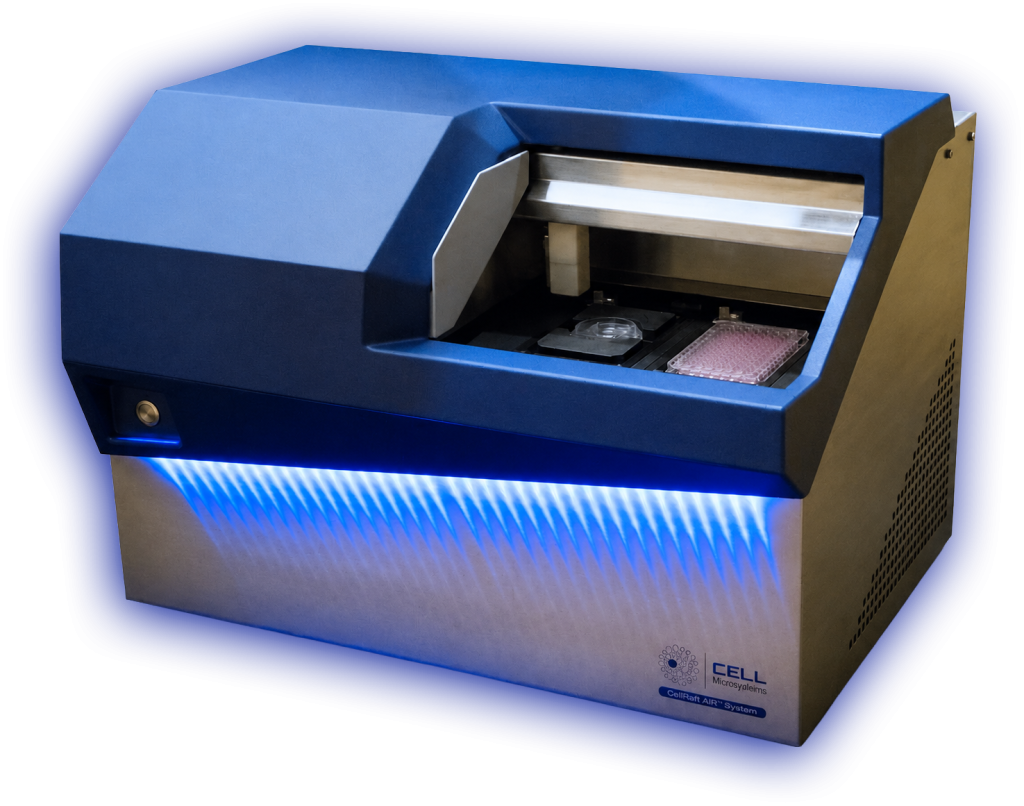
CellRaft AIR® System
Single Cell Isolation and Clone Generation System
Designed to support colony verification and outgrowth tracking through imaging-based monitoring, with clone isolation occurring only once viability is confirmed.
How CellRaft AIR works
Culture first. Verify over time.
Isolate after viability is confirmed.
1. Shared media environment
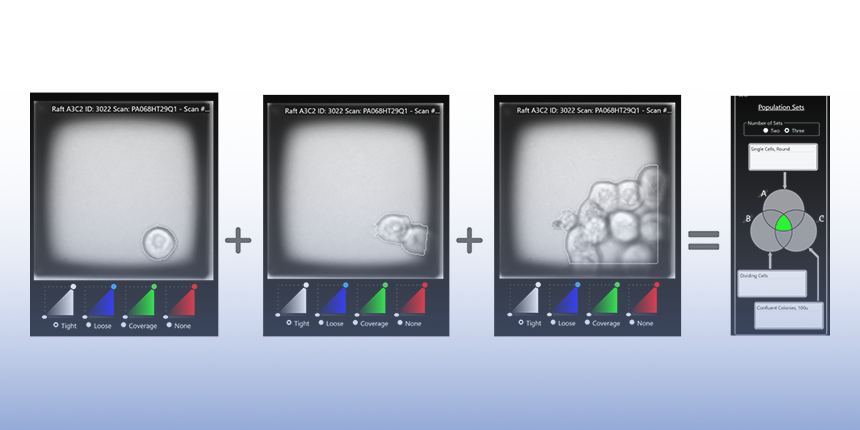
2. Time-course imaging and monoclonality documentation
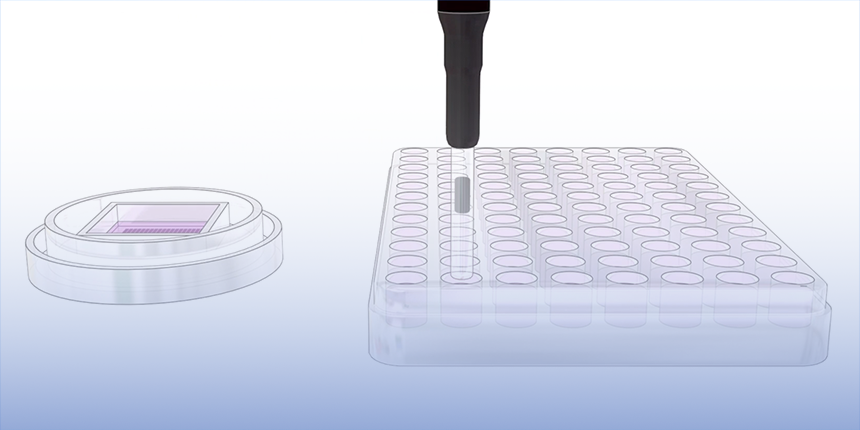
3. Image-guided isolation with AI-assisted retrieval verification
"...a recent demonstration of this technology in the lab has shown that, compared to current methods, the CellRaft AIR system increases the number of clones obtained by 5-fold and reduces the time needed to obtain those clones by 50% ...increasing the probability of obtaining a clone of interest while reducing waiting time."
"At Colossal Biosciences, we only work with non-model organisms and primary cells and cell lines that haven’t been studied before. These cells often fail to grow out after monoclonal isolation using flow sorting. In the few months since adopting the CellRaft, we have isolated thousands of validated monoclonals from various species with consistent outgrowth efficiencies."
See Colossal's Innovative Research in Reviving Extinct Species like the Woolly Mammoth. See it on CNN.
"We can now easily identify thousands of single organoids with various morphologies (size, shape, complexity) and isolate hundreds in less than an hour. We also use the CellRaft AIR System for cloning of transgenic or CRISPR-edited human intestinal stem cells. Prior to the air system, the efficiency of isolating clonal lines was very inefficient because of the low throughput. Now we can isolate hundreds or thousands of clonal organoids in an unprecedented short amount of time compared to before."
"Several adherent lines tested in the lab do not survive sorting at high pressure and their outgrowth is poor when sorted singly in plates. Manually limiting dilution was previously the only process for obtaining clones; however, we can now utilize the CellRaft AIR® System for adherent lines as well."
"We recommend the CellRaft Technology for our colleagues struggling with single cell isolation. Even with help from FACS, although single cell clones could be obtained, from our experiences, CellRaft not only speeds up this process by providing many more clones but more importantly, the unique monitoring process provided by CellRaft supplies additional information for every single clone with a higher quality of clones ."
“We are the cell engineering group that provides engineered cancer cell lines for cell-based assays to groups across the organization. We have purchased a second CellRaft AIR for our operations as CellRaft AIR has replaced limiting dilution and, to some extent, flow sorting in our workflow. Our workflow demands engineered cells that need to be developed into monoclonal colonies.
A huge advantage for us is the ability to track and trace monoclonality via imaging. I am glad that the response from Cell Microsystems has always been fast in supporting our usage and adoption of the system. The switch to Cellraft Arrays has resulted in a dramatic decrease in reagent usage while increasing our productivity by 2 to 3 fold.”
Top 10 Global Biopharma Organization in New York City
“We employed the CellRaft Technology to help isolate clones derived from verified single cells in a cell line that was very difficult to clone by regular limiting dilution. It worked beautifully, producing clones with sequencing-verified distinct genotypes quite easily. This technology is definitely a big advance for anyone trying to isolate clones from single cells!!”
“Our work routinely involves knocking in two or more unrelated fluorescent proteins into a single cell line by lentiviral methods. A significant challenge has been the isolation of strongly expressing all-positive clones for use as reporters. A more facile approach to knocking in and isolating such clones would greatly accelerate our work over engineering alternative construct designs. Cell Microsystems was able to isolate clones of THP-1 monocytes that are highly fluorescent for our assays. I would recommend this technology (CellRaft Technology) as a viable alternative to FACS, especially when cell populations are limiting.”
Explore by Application
Designed for These Workflows
Use CellRaft AIR across clone-generation and antibody discovery workflows.

Clone generation
from iPSCs

Gene-edited
clone generation

Fragile or
difficult-to-clone cells

Antibody discovery
workflows
Key Benefits
Better Clones.
Stronger outcomes.
The CellRaft AIR can increase the number of viable colonies recovered compared with limiting dilution, with the exact improvement depending on cell type, workflow, and supporting study data.
- Designed for fragile and difficult-to-clone cells, including iPSCs and gene-edited cell lines
- Colony formation confirmed before retrieval, reducing selection of non-viable isolates
- Imaging-based workflow supports reproducibility and experimental consistency
- Helps provide more viable clones for downstream applications
- Supports verified clonal outgrowth and colony tracking prior to selection
- No fluidics-based stress during the isolation step
Module available as an add-on license
Regulated Research Workflows
Supporting 21 CFR Part 11 electronic records workflows
Regulated Research Workflows
Supporting 21 CFR Part 11 electronic records workflows
Module available as an add-on license
Product Demo Video
Rapid Imaging | Software-Guided Identification | Automated Isolation
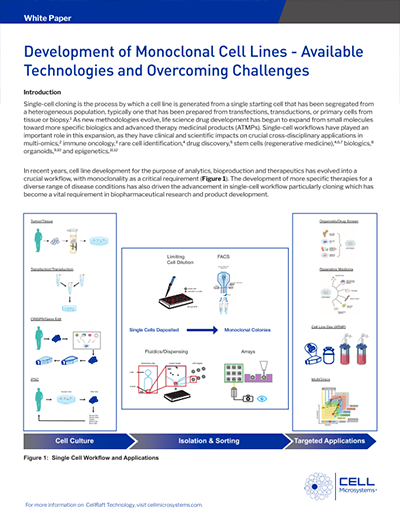
Development of Monoclonal Cell Lines — Available Technologies and Overcoming Challenges
Who is Using CellRaft Technology?
Journal Article: Detection of unintended on-target effects in CRISPR genome editing by DNA donors carrying diagnostic substitutions
Journal Article: Pooled image-base screening of mitochondria with microraft isolation distinguishes pathogenic mitofusin 2 mutations
Journal Article: A rare human centenarian variant of SIRT6 enhances genome stability and interaction with Lamin A
Journal Article: PDS5A and PDS5B differentially affect gene expression without altering cohesin localization across the genome
Journal Article: RNA binding protein SYNCRIP maintains proteostasis and self-renewal of hematopoietic stem and progenitor cells
CellRaft Technology FAQs
We already have a cell sorter. Why consider CellRaft AIR?
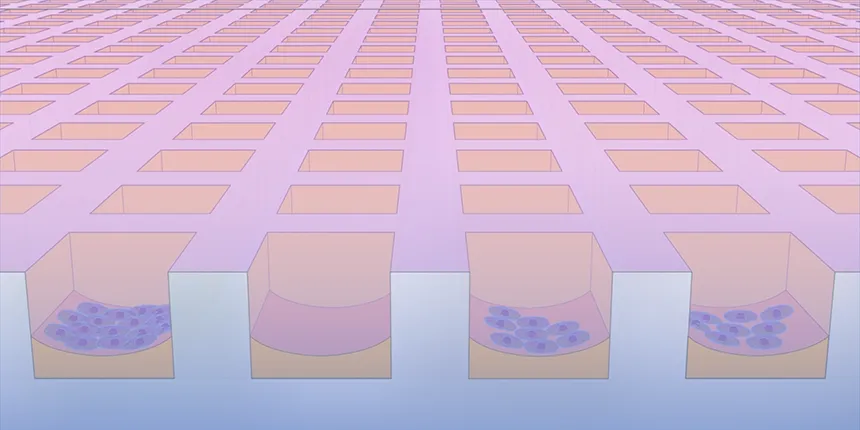
The question is often not isolation itself, but downstream viability, clone outgrowth, and confidence in resulting colonies. Sorters can deliver isolated cells that fail to produce viable clones. CellRaftA microscale polystyrene growth surface within an array used to spatially segregate cells/colonies while maintaining shared media access, enabling imaging over time and targeted isolation. AIR is optimized for workflows where fragile-cell preservation, colony monitoring, and outgrowth confidence matter. Cells remain in culture through colony formation before retrieval, with no fluidics-based stress during isolation.
Why not use single-cell dispensing?
Dispensing may isolate cells successfully while still failing to produce viable or useful downstream clones. The gap between isolation and verified outgrowth is where many workflows fail. CellRaft AIR supports workflows where colony formation is confirmed by imaging before any retrieval occurs, supporting confidence in downstream results.
How does CellRaft AIR support monoclonality documentation?
CellRaft AIR supports time-course imaging that tracks colony development from a single cell through colony formation. This image-based track-and-trace approach provides evidence that a colony originated from a single cell across its development, rather than relying on a statistical probability argument or a snapshot at a single point in time. This is a differentiator for cell line development, cell therapy research, and regulated research environments where monoclonalityEvidence that a colony/line originated from one cell; often supported by time-course imaging and traceability. documentation is required.
How does CellRaft AIR handle fragile or difficult-to-clone cells?
Fragile cells — including iPSCs and gene-edited cells — often fail in isolation-first workflows because immediate isolation removes them from the supportive shared culture environment. CellRaft arrays support a shared media environment at single-cell resolution, allowing individual cells to grow under flask-like conditions before retrieval. This is a primary mechanistic reason these cell types can survive and form viable colonies in workflows where sorting-based or dispensing-based approaches may create additional stress or reduce downstream outgrowth.
What is the best way to isolate edited cells after CRISPR editing?
The best way to isolate edited cells after CRISPR editing is to use a method that supports cell recovery while enabling selection based on phenotype or growth. CellRaft AIR allows researchers to culture edited cells in a gentle, shared media environment and then isolate viable colonies after they have expanded, improving recovery of sensitive or low-efficiency edits compared to single-cell deposition methods.
Is there an advantage to CellRaft AIR over limiting dilution?
With standard limiting dilutionA statistical cloning approach where cells are diluted to low density to “hopefully” seed one cell per well; commonly used but can be low-efficiency for difficult-to-clone lines., it can take several weeks to develop a colony that’s difficult to track back to its single cell of origin, along with significant hands-on time, consumables, and media use. CellRaft AIR is designed to shorten this workflow and reduce consumable and media usage, while keeping cells in flask-like culture until a colony forms and is confirmed before isolation — supporting healthier, more viable downstream clones.
CellRaft Technology FAQs
The question is often not isolation itself, but downstream viability, clone outgrowth, and confidence in resulting colonies. Sorters can deliver isolated cells that fail to produce viable clones. CellRaft AIR is optimized for workflows where fragile-cell preservation, colony monitoring, and outgrowth confidence matter. Cells remain in culture through colony formation before retrieval, with no fluidics-based stress during isolation.
Dispensing may isolate cells successfully while still failing to produce viable or useful downstream clones. The gap between isolation and verified outgrowth is where many workflows fail. CellRaft AIR supports workflows where colony formation is confirmed by imaging before any retrieval occurs, supporting confidence in downstream results.
CellRaft AIR supports time-course imaging that tracks colony development from a single cell through colony formation. This image-based track-and-trace approach provides evidence that a colony originated from a single cell across its development, rather than relying on a statistical probability argument or a snapshot at a single point in time. This is a differentiator for cell line development, cell therapy research, and regulated research environments where monoclonality documentation is required.
Fragile cells — including iPSCs and gene-edited cells — often fail in isolation-first workflows because immediate isolation removes them from the supportive shared culture environment. CellRaft arrays support a shared media environment at single-cell resolution, allowing individual cells to grow under flask-like conditions before retrieval. This is a primary mechanistic reason these cell types can survive and form viable colonies in workflows where sorting-based or dispensing-based approaches may create additional stress or reduce downstream outgrowth.
A strong approach for isolating edited cells after CRISPR editing is one that supports cell recovery while enabling selection based on phenotype or colony growth. The CellRaft AIR System allows researchers to culture edited cells in a shared media environment and isolate viable colonies after expansion — which may improve recovery of sensitive or low-efficiency edits compared to single-cell deposition methods.
With standard limiting dilution, it can take several weeks to develop a colony that's difficult to track back to its single cell of origin, along with significant hands-on time, consumables, and media use. CellRaft AIR is designed to shorten this workflow and reduce consumable and media usage, while keeping cells in flask-like culture until a colony forms and is confirmed before isolation — supporting healthier, more viable downstream clones.